


Whether someone is years away from retirement or has been collecting benefits for years, one question comes up again and again: “Will Social Security still be there when I need it?” It’s an understandable concern. Headlines warning that Social Security is “running out of money” can make it sound as though the program is on the verge of disappearing.
In fact, surveys show that nearly 40% of Americans believe Social Security benefits will stop completely once the trust fund is depleted.
But that’s not what the projections show. Social Security faces a long-term financing challenge, but “trust fund depletion” does not mean benefits disappear. Understanding the difference can help cut through some of the noise—and avoid unnecessary fear.
What is the Social Security Trust Fund?
Social Security is primarily funded through payroll taxes paid by workers and employers. In most years, those payroll taxes are used to pay benefits to current retirees. However, following bipartisan reforms in 1983, the program began collecting more revenue than it needed to prepare for the retirement of the Baby Boom generation—an unusually large generation that would eventually place greater demands on the system. Those excess payroll tax contributions were invested in special U.S. Treasury securities and accumulated in the Social Security trust fund. In effect, Baby Boomers were partially pre-funding their own retirement benefits during their working years.
Throughout the 1980s, 1990s, and early 2000s, the trust fund grew substantially. Around 2010, Social Security began paying out more in benefits than it collected in payroll taxes and started drawing on those reserves to make up the difference. The trust fund is not a pile of cash sitting in a vault; it consists of Treasury bonds that earn interest and are backed by the federal government. When Social Security needs the money, those bonds are redeemed and the Treasury repays the principal and interest.
The projected depletion of the trust fund is not a surprise. In fact, policymakers have known for decades that the reserves would eventually be drawn down as Baby Boomers moved from their working years into retirement. Current projections estimate that the trust fund reserves will be depleted around 2034. That date has generated plenty of alarming headlines, but it is often misunderstood.
Trust fund depletion does not mean Social Security benefits go to zero.
Even if the trust fund reserves are exhausted, Social Security would continue to receive payroll tax revenue. That ongoing income would still be enough to cover roughly 78% of scheduled benefits. In other words, “running out of money” does not mean benefits fall to zero. It means Social Security would no longer have reserves available to supplement incoming revenue.
Why Has the Outlook Changed Over Time?
It’s easy to blame demographics alone—declining birth rates, longer life expectancies, and lower immigration have all contributed to fewer workers supporting a growing retiree population. However, economics has played an important role as well. For years, wage growth became increasingly concentrated among higher-income earners. Social Security payroll taxes are only applied up to an annual wage cap—$184,500 in 2026. Income above that amount is not subject to Social Security taxes. As a result, much of the strongest wage growth occurred above the taxable maximum, while wage growth for many middle- and lower-income workers stagnated.
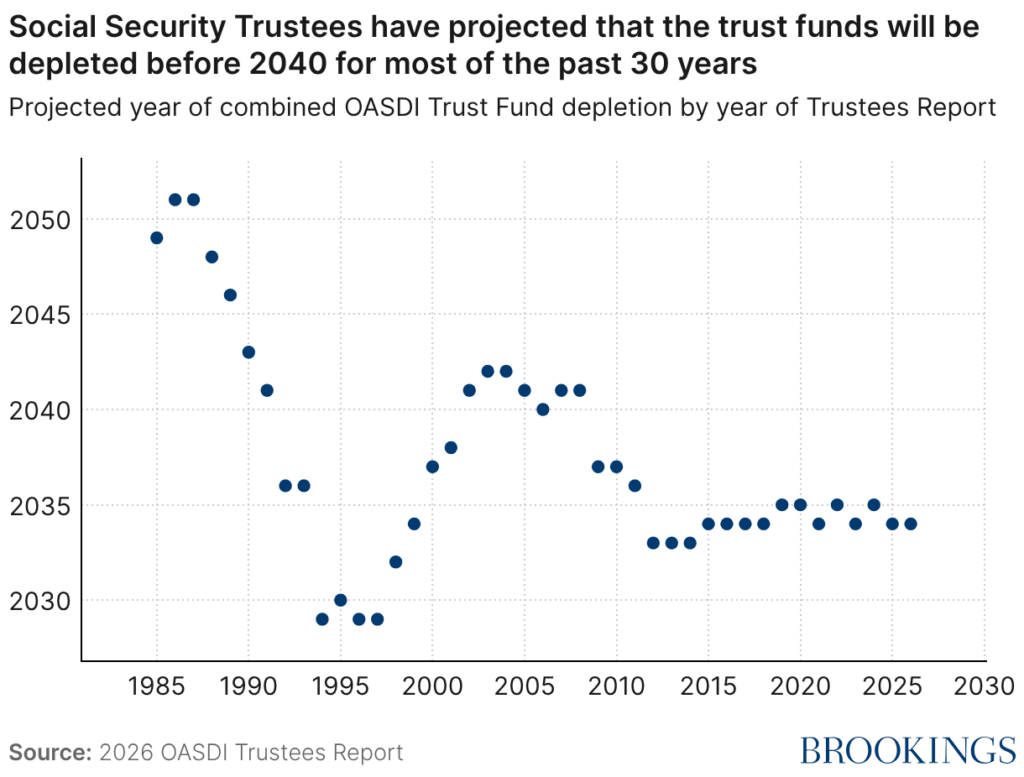
The Great Recession also accelerated the trust fund’s decline. Beginning in 2008, millions of jobs were lost, reducing payroll tax revenue. Some workers retired earlier than expected and claimed benefits sooner, while the labor market took years to recover. This led to shifts in projected depletion dates over time. Shortly after the 1983 reforms, projections suggested the trust fund would last until around 2050. Since then, estimates have moved earlier and later as economic conditions changed. (See image below)
What Happens If Congress Does Nothing?
If Congress were to take no action before trust fund reserves are depleted, benefits would likely need to be reduced across the board by roughly 17%-22% to match incoming revenue. While that outcome would certainly be painful, it is important to recognize that it represents the worst-case scenario—not the most likely one.
Social Security is now more than 90 years old and has never missed a monthly payment. Congress has known about the program’s long-term financing challenges for decades, and history suggests lawmakers tend to act when reform becomes unavoidable. That’s exactly what happened in 1983.
What Could Congress Do?
Raise or Eliminate the Payroll Tax Wage Cap – Many policymakers have suggested applying Social Security payroll taxes to a greater share of earnings. As mentioned above, income above $184,500 in 2026 is exempt from Social Security taxes. Expanding the taxable wage base would increase revenue and help address the funding gap.
Tap Other Revenue Sources – Another possibility is expanding the sources of revenue used to fund Social Security, such as applying taxes to certain forms of investment income.
Increase Full Retirement Age – Another possibility is increasing the Full Retirement Age, similar to reforms enacted in 1983. Prior to those changes, the Full Retirement Age was 65. Congress gradually increased it to age 67 for people born in 1960 or later. The changes were phased in over decades and did not affect individuals already receiving benefits. Workers born in 1960—the first group subject to age 67—were only 23 years old when the law was passed, illustrating how reforms are typically implemented gradually with significant advance notice.
Adjust Benefits or Cost-of-Living Increases – Other proposals include modest payroll tax increases, changes to benefit formulas, adjustments to how annual cost-of-living increases (COLAs) are calculated or means testing for higher-income retirees.
Avoid Further Tax Cuts – The One Big Beautiful Bill Act did not eliminate federal income taxes on Social Security benefits, but it did reduce taxes for many beneficiaries through a new senior deduction. As a result, less tax revenue is expected to flow back into the Social Security trust funds than would have under prior law. Avoiding further reductions in that revenue is one option Congress could consider when addressing the program’s long-term solvency.
The Bottom Line
These approaches are not mutually exclusive, and any eventual reform would likely involve a combination of changes. Ultimately, addressing Social Security’s long-term solvency will require action from Congress. If this issue is important to you, consider contacting your members of Congress to encourage them to prioritize a long-term solution.
Social Security remains one of the most valuable components of retirement income, providing guaranteed, inflation-adjusted lifetime benefits, along with survivor and disability protections that are difficult to replicate in the private market.
In our financial planning process, we take a holistic approach that looks beyond ideal outcomes and considers a range of real-world risks. That includes stress testing for scenarios such as market volatility, inflation, longevity, and potential reduction in Social Security benefits, helping ensure a plan remains resilient across different environments.

About the Author
Samantha Vicchiarelli, CFP®, ChFC®
Samantha’s journey into financial planning was inspired by her own personal experience of unexpectedly becoming a caregiver for an aging parent. Faced with the task of managing financial decisions without proper guidance, she felt compelled to channel her insights into assisting others facing similar challenges, providing them with the guidance and resources needed for peace of mind.
Certified Financial Planner Board of Standards Center for Financial Planning, Inc. owns and licenses the certification marks CFP®, in the United States to Certified Financial Planner Board of Standards, Inc., which authorizes individuals who successfully complete the organization’s initial and ongoing certification requirements to use the certification marks. The ChFC® is the property of The American College of Financial Services, which reserves sole rights to its use, and is used by permission.